
Infrared Thermal Inspection
How One Infrared Inspection Saved Lansing Public Schools $11.3 Million
Lansing Public Schools was facing a full roof replacement recommendation with a projected cost of $11.3 million. An independent infrared inspection found 93% of the membrane was still structurally sound. The district repaired rather than replaced.
[Client quote pending]
Facilities Director, Lansing Public Schools
The situation
A full replacement recommendation and an $11.3M budget decision.
Lansing Public Schools had received a contractor recommendation for full roof replacement across their building portfolio. The projected cost was $11.3 million. The district was preparing to proceed.
Before committing to the bond, a facilities administrator requested an independent assessment. Heartland was engaged to conduct a Level 3 infrared thermal inspection of the entire portfolio.
The contractor recommendation had been based on visual inspection and age-of-membrane heuristics. No thermal imaging had been performed. No core samples had been taken. The recommendation was a default: when contractors cannot see clearly, they recommend replacement.
What Heartland found
93% of the membrane was still structurally sound.
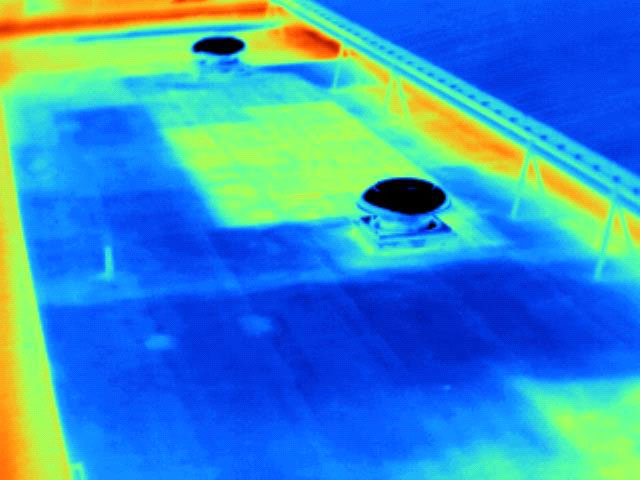
The Level 3 infrared inspection mapped moisture saturation across every section of every roof in the portfolio. Thermal signatures were validated with physical core samples at identified anomalies.
The finding: 93% of the total membrane area was dry, intact, and performing within specification. Moisture was present in isolated sections at four of the buildings, all repairable at a fraction of the replacement cost.
The contractor recommendation had been categorically incorrect. Not a matter of judgment, but a matter of data that was not gathered. A visual inspection of an aging roof will always trend toward replacement. Infrared thermography removes the guesswork.
The outcome
Targeted repair instead of full replacement. $11.3M not spent.
The district used the Heartland report to challenge the replacement recommendation. Targeted repairs were carried out on the identified moisture-affected sections. The bond was not issued.
The inspection fee was recovered at a ratio of 580:1. The documented saving of $11.3M is based on the contractor quote versus the actual repair cost. Both figures are on record.
The Lansing report has since been used as a template for how school districts should approach capital roof decisions. An independent infrared inspection before any replacement recommendation is accepted is the standard Heartland recommends to every district it works with.
For Nebraska School Districts
If you manage roofing for a Nebraska school district, our free assessment can help you understand your situation before your next capital decision.
Next step
Ready to challenge your replacement recommendation?
An independent infrared inspection costs a fraction of a replacement project. The Lansing outcome is documented proof of what that difference can be.